Cooplexity Model: Six Steps to Develop Trust
Cooplexity is a collaboration-in-complexity model spanning three levels of work: individual, group, and organisational. This model focuses on management during times of uncertainty and change, promoting cooperation and teamwork to achieve common goals, tackling complex challenges, and enhancing decision-making and problem-solving efficiency in dynamic environments.
"Towards a trust-based culture."
In complex, uncertain, and changing environments, an organisation's effectiveness no longer relies solely on its structure or processes. It depends above all on its ability to generate and sustain trust.
Trust is not a state: it is a journey. It is not decreed or demanded but built step by step, in a relational, cultural, and progressive manner.
The Cooplexity model proposes this path precisely: six steps that guide organisational transformation from individual management to distributed leadership, with trust as the central axis.
Article Content
Starting Point: The CUTE Context
Before traversing the six steps, it is essential to understand the terrain. The Cooplexity model begins with a prior diagnosis: recognising that we operate in a context we call CUTE.
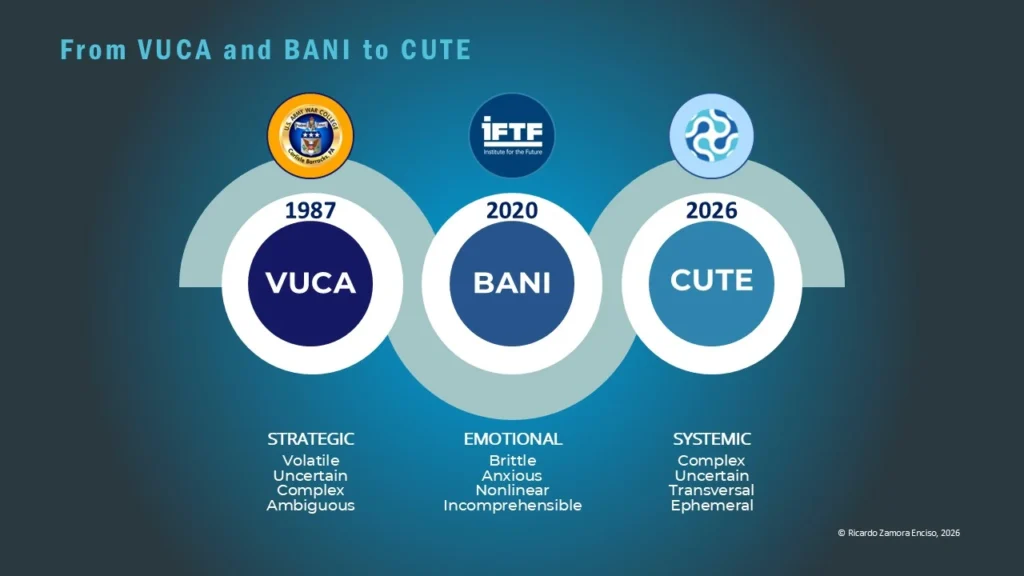
CUTE is an acronym describing four interconnected dimensions of the current environment:
Complex: Multiple variables interact simultaneously, creating interdependencies that no single individual can fully manage. Results emerge from interactions rather than linear cause-and-effect relationships.
Uncertain: The future cannot be reliably predicted. Uncertainty arises from the lack of shared references and stable expectations.
Transversal: Capabilities, knowledge, and influence transcend traditional boundaries. Roles, disciplines, and organisations overlap, forming dense networks of mutual dependence.
Ephemeral: The combination of the above factors generates an oversupply of actions and messages. Visibility becomes scarce, attention fleeting, and impact fragile.
In a CUTE context, traditional competitive responses prove insufficient. What is needed is a complete organisational transformation requiring communication, commitment, and coordination. The six steps of the Cooplexity model provide exactly that path.

Model Introduction
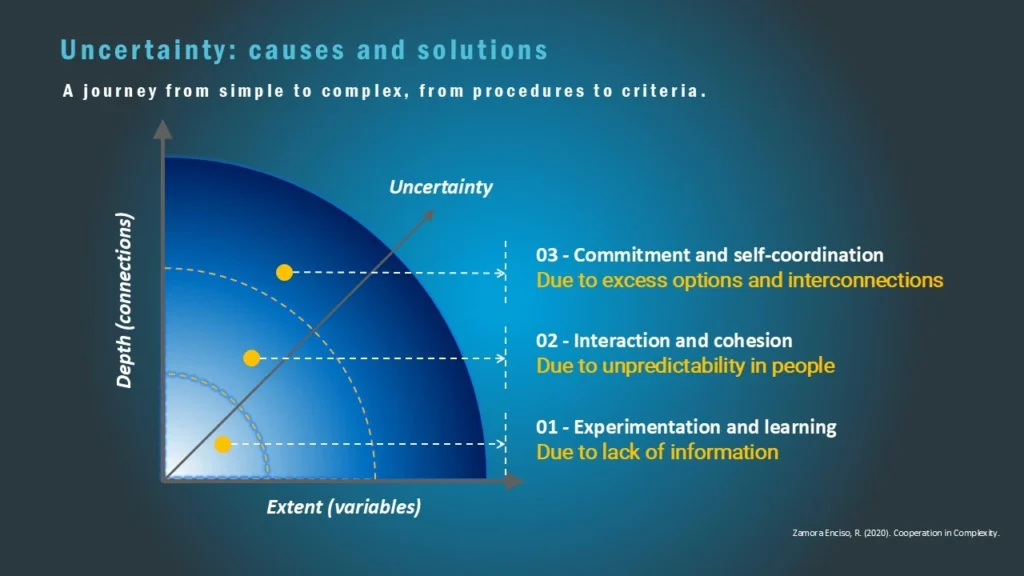
The Cooplexity model proposes six steps to develop trust, organised into three maturity levels: Knowledge (steps 1 and 2), Cohesion (steps 3 and 4), and Self-Coordination (steps 5 and 6).
As we progress through these levels, the protagonist evolves too: from the individual to the team, and from the team to the organisation. This shift in scope reflects how trust expands progressively from the personal to the systemic.
Knowledge Level

"I Know How to Do It."
The first level focuses on the individual scope and aims at acquiring both functional and relational knowledge. In this phase, self-knowledge and information are fundamental. Learning is the key process
There exists an element that can act as a catalyst: exploration. In an unknown environment, learning occurs through experimentation. Proactive exploration—oriented toward results and relationships—leads to experimentation and, with it, learning.
Cohesion Level
Photo by Michał Parzuchowski on Unsplash
"We Want to Do It."
The second level operates in the group and team scope, centring on internal dynamics and interactions among members. Here, cohesion develops around a shared project and common purpose.
The common project is the catalyst in this case. The existence of a shared goal becomes the engine of cohesion. The group's effort to align interests—balancing individual and collective ones—is essential for team formation.
Self-Coordination Level
"We Are Doing It."
The third level reaches the organisational scope, where teams become aware of themselves as a new entity and self-coordinate using available space to act. This is the stage of decentralisation and distributed leadership.
The catalysts now are interconnections. For self-coordination to emerge, conditions must favour individual initiative and spontaneous leadership. Interconnections enable cross-knowledge of agents, their activities, interests, and needs.
The Six Steps of the Model
Each step represents a specific dimension of trust. Together, they form a progressive journey from individual self-confidence to systemic trust.
Step 1. I Trust Myself – Uncertainty Management
Every transformation starts individually. Learning to manage anxiety, tolerate error, and act without certainties is the first act of trust: the self-confidence needed to decide in complex contexts.
Step 2. Do You Trust Me? – Relationship Management
No cooperation without bonds. The second step focuses on building relationships through listening and empathy. Before coordinating, we need to relate from a place of authenticity and emotional connection.
Step 3. I Trust the Project – Interest Management
In human systems, divergent interests are not anomalies: they are the norm. This step proposes balancing those differences around a common project, where cohesion arises from shared commitment rather than uniformity.
Step 4. I Trust the Purpose – Management by Values
When we act out of interest, we compete. When we act in line with our values, we cooperate. This step elevates the conversation: from the useful to the meaningful, from the immediate to the sustainable. Trust is rooted in a shared and coherent purpose.
Step 5. I Trust Difference – Change Management
Change thrives on diversity. But it flourishes only in a culture that allows debate, dissent, and proposals without fear and with respect. Assertiveness emerges here as the tool to build from difference, not despite it.
Step 6. I Trust the System – Distributed Organisation
The model's endpoint is decentralisation. Trust becomes culture. Leadership ceases to be a role and becomes an emergent property of the system. Here, everyone can lead because the system is designed to allow it.
It is a journey for teams that want not only to be more effective but also more human, more aware, and more connected to their own potential.
Model Architecture: Overview
The following table summarises the relationship between levels, scopes, steps, and catalysts:
Level | Scope | Steps | Key Phrase | Catalyst |
|---|---|---|---|---|
Knowledge | Individual | 1. Uncertainty Management | "I know how to do it" | Exploration |
Cohesion | Group / Team | 3. Interest Management | "We want to do it" | Common Project |
Self-Coordination | Organisational | 5. Change Management | "We are doing it" | Interconnections |
Cooplexity as a Reference Framework
The Cooplexity model is a conceptual framework designed to enhance collaboration and leadership in complex environments. The term "Cooplexity" combines "cooperation" and "complexity," reflecting the model's focus on managing complexity through practical cooperation.
"A culture that evolves with people."
Cooplexity is not a technical framework. It is a living model that accompanies organisational evolution from the individual to the collective, and from hierarchical to distributed.
Critical aspects of the Cooplexity model include:
- Human organisations are complex systems: Emphasising that organisations and teams often operate in environments with numerous interdependent factors. This complexity demands adaptable and flexible approaches to leadership and collaboration.
- Systems thinking: Navigating a complex, interdependent world requires a broad enough view to identify emergent behaviours in social, economic, and political movements. Only thus can we escape reductionist and homogenising simplicity.
- Shared leadership: The model promotes distributed leadership, where leadership is shared among teams rather than concentrated in one individual. This enables a more dynamic and adaptive way to address challenges as they arise.
- Cooperation as a principle: The model holds that cooperation is essential for success in complex environments. It encourages teams to focus on collective problem-solving, open communication, and trust-building to navigate uncertainty effectively.
- Emergence: In line with complexity theory, Cooplexity highlights the importance of emergence, where new solutions or outcomes arise from collective interactions within a system. Leaders and teams are encouraged to remain open to unexpected solutions that emerge from collaborative efforts.
- Participative leadership: Leaders in this model must deliberately create conditions for distributed leadership to thrive, adapting their style and approach to the situation rather than adhering to rigid management structures.
- Continuous learning and feedback: The model encourages organisations to adopt a learning culture where ongoing feedback cycles help teams learn from successes and failures. This iterative process allows the system to evolve and better manage future challenges.
By integrating these elements, the Cooplexity model aims to help teams and organisations thrive in unpredictable and complex environments, fostering greater collaboration, distributed leadership, and adaptive responses to change.
About the Research
The Cooplexity model emerged from a rigorous ten-year research effort, including five years of systematic data collection on managerial behaviour in environments of growing interdependence and complexity.
Methodology used
The empirical methodology, based on simulation as the primary tool, uses the Synergy simulator to recreate real decision-making situations under uncertainty. Direct observation in training groups (T-groups) identified recurrent behaviours without inducing them, allowing unbiased variable categorisation. Data were processed using statistical analyses, such as optimal scaling and factorial analysis, in SPSS to validate causal relationships among complexity, decisions, and results.
Sample and Setting
The sample included 52 two-day face-to-face courses during the period 2002-2007, with more than 600 managers from 12 sectors, including multinationals and large companies such as Danone, REE, or Lafarge, grouped in groups of 12 participants on average, who managed interrelated projects with scarce resources. Synergy, developed between 1997 and 1999 with inputs from systems theory and complexity, generated results linkable to behavioural observations, maximising realism, control, and generalisability.
Key Tool: Synergy
Synergy reflects departmental transversality and multidisciplinary, fostering the emergence of spontaneous collaboration rather than pre-assigned roles. Its design prioritised fidelity to complex reality over prior theories, enabling precise measurements of indices such as complexity (project interconnections) and interrelation, with 70.2% of variance explained in performance.
About the Author
Ricardo Zamora is the author of the Cooplexity model, a trust development framework for achieving cohesive, committed, and self-coordinating teams.
He holds a BBA and an MBA from ESADE, a Master's in Coaching, and a Master's in Management Development and Leadership from the University of Barcelona (UB).
Specialised in distributed and participative leadership—a transformative approach that empowers teams by involving everyone in decision-making—he uses experiential learning, supported by gamification, to reach emotions. He works on talent development, team dynamics, and organisational culture to foster innovation and collaboration at all levels.
He has been an adjunct professor in ESADE Business School's People Management and Organisation Department since 2000.
Also, an entrepreneur, he founded Training Games in 1995 (team training with gamification) and the Cooplexity Institute in 2011 (a non-profit project to disseminate the Cooplexity model).
Fourteen IBEX-35 companies, along with large firms and multinationals, are among his direct clients.
He has taught courses in countries including Argentina, Brazil, China, Spain, the Netherlands, Italy, Mexico, the UK, and the USA.
He is a member of the North American Simulation and Gaming Association (NASAGA) and the System Dynamics Society.
Reference
Zamora, R. (2020). Cooperation in complexity: Cooplexity, a model for collaboration in complexity in times of uncertainty and change. Ricardo Zamora.
ResearchGate