Image: Spider-web photograph by Dr Helen Kara, used under Creative Commons Attribution 4.0 International (CC BY 4.0).
Source: https://helenkara.com/2015/07/28/data/
Beyond VUCA: the CUTE scenario
I work with several clients in the wine industry. When we discuss their market situation, it often comes across the same way: concern mixed with bewilderment. They identify problems in every direction—and none of the familiar solutions seem to fit.
Climate change affects both the quantity and quality of production. Younger consumers prefer beer. Restaurants are raising wine prices, making the best bottles prohibitively expensive. Alcohol is increasingly perceived as unhealthy.
Each problem, treated in isolation, could be linked to particular solutions: buying land in higher or cooler areas, producing younger wines with lower alcohol content, negotiating corkage agreements with restaurants, and associating wine with moments of social connection.
But when we look at the whole picture, something else emerges. Perhaps what we are witnessing is a more profound cultural transformation—one in which aged wines, expert tastings, and serious labels face a paradigm shift.
If that is the case, local solutions will have limited impact. What is needed is a complete organisational transformation at all levels, requiring communication, commitment, and coordination.
There is a name for this kind of context—and a framework for navigating it.
Cooplexity is a portmanteau word that stands for Cooperation in Complexity. It describes both the context and the solution. The Cooplexity model offers a six-step path to build the trust that enables genuine collaboration—but before walking that path, we need to understand the terrain.
Article Content
CUTE Scenario
The current environment, beyond VUCA, can be understood through four interconnected dimensions:
Complex
Multiple variables interact simultaneously, generating interdependencies that no isolated individual, role, or silo can fully understand or manage. Outcomes emerge from interactions rather than from linear cause-and-effect relationships.
Uncertain
The future cannot be reliably predicted—not only regarding what will happen, but also which options matter, how others will act, and which criteria should guide decisions. Uncertainty arises from the absence of shared references and stable expectations.
Transversal
Capabilities, knowledge, and influence cut across traditional boundaries. Roles, disciplines, organisations, and industries overlap, creating dense networks of mutual dependence where actions propagate quickly and unintentionally.
Ephemeral
The combination of complexity, uncertainty, and transversality produces a massive oversupply of actions, messages, and initiatives. Visibility becomes scarce, attention short-lived, and impact fragile.
These four dimensions do not operate in isolation. They reinforce each other, creating an environment where traditional management approaches—based on prediction, control, and siloed expertise—systematically underperform.
From VUCA and BANI to CUTE
From my perspective, VUCA, proposed in 1987 by the U.S. Army War College, optimises decision-making under conditions of uncertainty, with a typical response of better analysis and faster decisions. BANI, proposed in 2020 by the Institute for the Future (IFTF), optimises psychological survival, with a typical response of resilience, protection, and self-regulation. I suggest CUTE for today's context, focusing on optimising collective effectiveness through trust, cooperation, and self-coordination.
Header | VUCA | BANI | CUTE |
|---|---|---|---|
What it describes | An unstable and unpredictable environment | The psychological impact of extreme instability | An interdependent and saturated system |
Core focus | Volatility & uncertainty | Fragility & anxiety | Relationships & coordination |
Primary lens | Strategic / analytical | Emotional / psychological | Systemic / relational |
Implicit mindset | Control, planning, anticipation | Resilience, coping, protection | Cooperation, trust, balance |
Typical response | Better analysis, faster decisions | Emotional resilience | Self-coordination and collaboration |
Main limitation | Describes instability but offers little guidance on behaviour | Explains how it feels, risks fatalism | Requires a shift in mental and relational models |
These three frameworks reflect different ways of interpreting uncertainty and complexity. But there is a deeper distinction.
VUCA and BANI describe the environment and its effects. CUTE goes further: it also points to the only viable response.
In a world that is complex, uncertain, transversal, and ephemeral, kindness, generosity, and cooperation are not moral choices but systemic necessities. When we are deeply interconnected and mutually dependent, selfish strategies tend to intensify competition, reduce available options, and destroy trust. By contrast, cooperative behaviours expand the solution space, preserve diversity, and allow new possibilities to emerge.
The objective is not self-sacrifice, but balance: preserving individual preferences while accepting partial resignations in favour of others, enabling coordination without uniformity and collaboration without losing autonomy.

Why Now?
Change is nothing new. Human societies and organisations have gone through profound transformations before. The quantity, speed, and impact of change have reached extreme levels in previous eras.
What is different today is not the change itself, but how changes interact. Transformations are deeply interconnected, and so are the reactions to them. These interactions produce counterintuitive outcomes, amplify disruptions, and generate systemic effects that cannot be understood or managed in isolation.
Consider the major forces reshaping business and society: the energy transition, digital acceleration, geopolitical realignment, demographic shifts, and the search for purpose at work. Each is typically analysed as a separate challenge, with its own experts, frameworks, and solutions. But look closer, and a shared pattern emerges.
The energy transition is not just an environmental issue—it simultaneously reshapes supply chains, talent requirements, customer expectations, and regulatory landscapes. Digital transformation does not stay within IT departments—it redefines business models, skills, and competitive boundaries across every function. Geopolitical shifts do not only affect international trade—they alter investment decisions, partnership strategies, and risk calculations at every level.
A single department, a single expertise, or a single decision-maker can solve none of these challenges. Each one creates ripple effects that cross organisational boundaries. And each one operates under time pressure that makes yesterday's solutions obsolete before they are fully implemented.
This is the shared pattern: not separate crises requiring separate responses, but different expressions of the same systemic context—a context that is Complex, Uncertain, Transversal, and Ephemeral.
The practical consequence is clear: competitive, siloed responses scale poorly. In a CUTE world, organisations remain effective only by increasing their capacity for trust, cooperation, and self-coordination—not as cultural ideals, but as operational necessities.
Uncertainty is here to stay
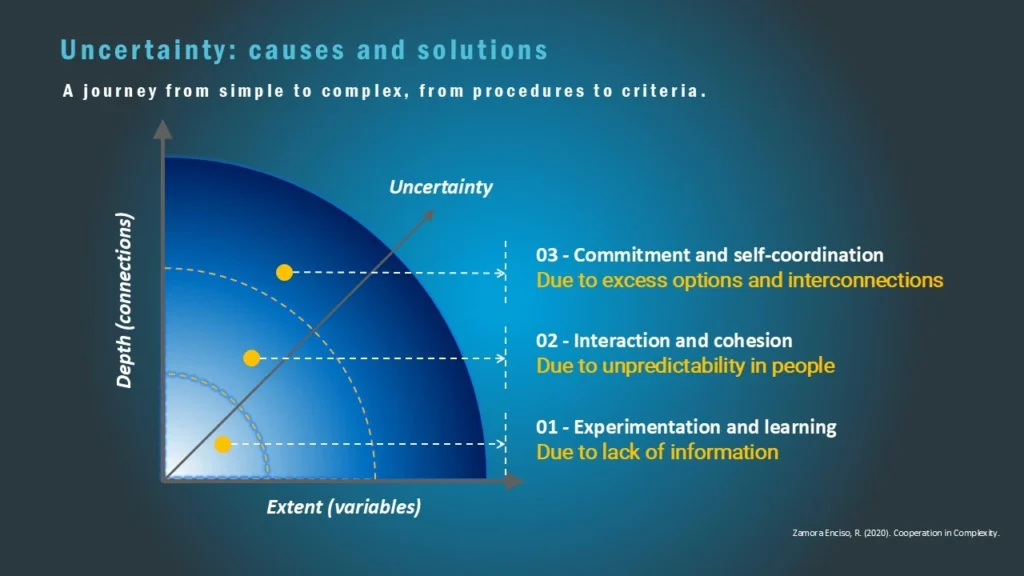
The simplest form of uncertainty is a consequence of a lack of information or knowledge. Nevertheless, uncertainty is more problematic when it arises from the sheer number of options, making it difficult to feel confident when making decisions. Both cases produce confusion and insecurity. They also generate anxiety, which is a dangerous companion, as it induces us to make decisions that reduce the feeling rather than the decisions we need to make. Human beings are perceptive, and reducing the feeling of anxiety can temporarily alleviate but not solve the underlying problem. Fortunately, systems thinking points out to us what to do.
Emergence

"Emergent behaviour defines culture."
Managing uncertainty can only be done from the same plane that generates an understanding of what uncertainty is or how it arises. If we group many people making similar individual decisions, we observe that they end up following common behaviour patterns that emerge naturally, consolidate spontaneously, and evolve or disappear as quickly as they emerged. This multiplicity of possible behaviours and the impossibility of predicting their evolution are what produce uncertainty. Nevertheless, it is possible to read those patterns and recognise the flow.
Evolution
"Evolution generates new options."
Understanding complexity requires training. It depends on the ability to read behaviours as the emergent response to many individual decisions. Living systems do not plan and are not governed by the decisions of anyone or anything. We must forget about the possibility of directly influencing those responses.
Behaviour evolves because of the dynamics of interaction. New realities are continually generated from individual or collective decisions that together create opportunities. We can accompany the flow and take advantage of the new possibilities that arise along the way.
Distinction
"We must know how to discriminate – there are no universal solutions."
All that diversity, all that wealth, is difficult to classify and to face. There are so many possibilities, so many options. The efforts of groups of individuals with common perspectives yet differentiated from one another make it challenging to determine what to do. It is essential to avoid simplistic solutions that might alleviate the anguish caused by ignorance but do not lead to the correct answer. As there are no manuals for the unknown, it is necessary to have criteria that let us navigate the future without blinding us in the short term.
Structure
"Structures influence behaviour."
How can we influence events? Although people's behaviour cannot be directly modified in a world of free will, limits on action can be set. These limits allow freedom of internal action while providing a degree of order and control. Finding the right balance between stimulating proactive behaviour and discouraging unwanted behaviours is the central challenge in deciding whether to expand or constrain these limits.
When the Right Diagnosis Isn't Enough
Years ago, I had the opportunity to collaborate with EMI Spain. At the time, the market was beginning its shift towards streaming. The company's main revenue streams were CD sales. They barely earned any income from concerts, unless these boosted physical sales.
In the workshops, all participants were fully aware of the situation, and their diagnosis was correct. However, when it came to finding solutions, they couldn't agree. They faced an impossible trade-off: imposing conditions on concert revenue risked losing major artists, but continuing to depend on CD sales while streaming grew meant watching their core business erode. Every option created friction elsewhere.
Ultimately, EMI was broken up and acquired by Universal Music Group and Sony/ATV. The most serious issue is that the company wasn't able to adapt, despite knowing the causes of the problem. Now it's easy to look back and make recommendations, but it certainly wasn't easy at the time. The digital transformation was a textbook CUTE environment: complex interdependencies between artists, labels, and platforms; deep uncertainty about consumer behaviour; transversal impact across production, distribution, and marketing; and an ephemeral window before the old model collapsed entirely.
If I had known then what I know now, I would have recommended solutions less focused on the business vision and more on involving all members of the company as fundamental contributors to generating ideas and adapting the whole organisation. Not because collective participation is a lovely ideal, but because in a CUTE context, no single perspective—however senior—can see the entire picture or command the coordination needed to respond.
EMI's story is not unique. Many organisations facing CUTE environments respond with fragmented strategies, siloed decisions, and top-down solutions that fail to mobilise collective intelligence. The question, then, is: what must organisations enable to respond differently?
What organisations must enable in a CUTE context?
In a complex, uncertain, transversal and ephemeral environment, organisations cannot rely on predefined solutions or best practices. What makes the difference is their ability to create the conditions under which effective responses can emerge.
This implies a shift from control to enablement, and from optimisation to coordination. In practical terms, organisations must focus on:
- Reducing uncertainty through shared understanding, rather than through over-planning. Learning, sense-making, and the continuous exchange of information become more important than prediction.
- Strengthening relationships and trust, as coordination in interdependent systems depends less on formal authority and more on the quality of interactions.
- Balancing interests explicitly, recognising their legitimacy and managing trade-offs to preserve a perception of fairness and long-term commitment.
- Anchoring decisions in values, providing stable reference points when rules, forecasts, and plans lose reliability.
- Distributing decision-making capacity, allowing local autonomy within a shared strategic framework, so that responses can adapt to fast-changing and highly connected conditions.
These are not cultural aspirations or leadership styles. They are structural requirements for operating effectively in a CUTE world, where no single actor can see, decide, or act alone.
These five capabilities are not abstract ideals. Each one corresponds to a concrete stage in the development of collaborative teams. The Cooplexity model maps this progression through six steps—from managing uncertainty to building distributed organisations—each one building on the trust generated by the previous.
The solution is giving space
Based on my experience as a consultant, I have repeatedly observed management teams demanding solutions that align more with what they wish to see than with what teams are actually capable of doing, willing to commit to, or believe makes sense.
The problem is rarely about who is right. It is about the lack of space for appropriate behaviours to emerge.
When solutions are imposed rather than enabled, both sides become trapped. Management assumes that prescribing answers can change behaviour, while teams underestimate how much their own reactions are shaped by the signals they receive. In reality, every action conditions the response that follows.
By leaving no room for experimentation, mistakes, and learning, organisations often obtain obedience — but not commitment. Over time, responsibility erodes, initiatives lose momentum, and problems persist. New efforts collide with a wall of indifference, not because people do not care, but because the system leaves little room to act differently.
This is why organisations must evolve from asking “what must be done?” to asking “what should we enable?”. The focus must shift from imposing the solution others should adopt to defining safe limits of action that allow decisions to be made, results to be observed, corrections to be applied, and new experiments to take place. Through this iterative process, learning emerges and adaptation becomes possible.
The answer is on the team
“No one has gone into the future and come back to explain what to do.”
If someone can't lead individually with all the answers, we'll need complementary efforts to cover the analysis, generate ideas, and push solutions into reality.
This idea opens the door to the concept of distributed leadership, a function, more than a role, which team members share in a common effort.
Distributed leadership refers to a spontaneous and interconnected set of initiatives. It's best understood as an emergent collective ownership of effective teams.
In this context, participative leadership is considered the intentional leadership style that facilitates this emergence. It reflects the leader's deliberate behaviour in creating the conditions for distributed leadership to thrive.
Both are structurally and functionally interconnected. Together, they challenge the traditional notion of leadership as a role-based function, highlighting that leadership is a cultural dynamic that must be intentionally cultivated throughout the organisation.
Conclusion
In this puzzle, collaborators play a fundamental role; they are people who are committed, collaborative, take the initiative and are proactive – talented, knowledgeable people, but more importantly, people who are eager to learn as the world evolves.
“Collaboration is only possible with the proper context.”
For its part, an organisation will need the structures and policies to attract and retain talented people, to pay attention to them, and to recognise their efforts and results. Talented people will seek diversity that provides multiple perspectives, enriches analysis, increases creative capacity, and generates solutions.
The organisation's culture will promote respectful treatment grounded in positive relationships and driven by emotional intelligence. Company values must be a true reflection of this way of acting.
Intelligence and responsiveness to risks and opportunities must be distributed to be effective. Collaborators will be able to apply their knowledge and select and understand relevant information appropriately.
Thus, we come to distributed leadership as a way to transform modern organisations into competitive and sustainable workplaces and as a catalyst for developing talent and enhancing professionals' wellbeing.
Next Step: The Path from CUTE to Trust
“CUTE defines the context; Cooplexity defines the path.”
The Cooplexity model is a scientifically validated framework for leadership development, built over five years of research with 50 teams and more than 700 participants across 12 sectors. It validates that collaboration improves outcomes in interdependent, complex contexts—and defines six progressive stages to strengthen trust.
Each step builds on the previous:
- Managing Uncertainty — building confidence through learning
- Managing Relationships — discovering others and finding complementarity
- Managing Interests — balancing contributions and benefits
- Managing by Values — acting with integrity and coherence
- Managing Change — embracing difference with mutual respect
- Distributed Organisation — decentralising decisions within shared strategy
Trust is the cornerstone of any relationship, and participative leadership is the vehicle that enables collaborative behaviours to emerge.
In the following article, we begin with the first step: how to manage uncertainty without letting anxiety drive our decisions.
Reference
Zamora, R. (2020). Cooperation in complexity: Cooplexity, a model for collaboration in complexity in times of uncertainty and change. Lulu.
https://www.researchgate.net/publication/349341671_COOPERATION_IN_COMPLEXITY