How to diagnose your team's level and intervene with precision
The Cooplexity model serves as a compass, guiding us through a map that leads to full trust. This article walks through the trust development stages one by one, so you can identify where your team stands and act accordingly.
Managers sometimes open up to me. Ricardo, I don't know what to do anymore. I've tried prioritising relationships over demands, encouraging personal development and linking it to results; we've run training sessions and workshops, and even organised a team-building event so everyone could get to know each other personally. There are people who only think about their own gain, who don't cooperate and who set a thoroughly undesirable example. I'm a calm, friendly person, but I'll be honest, there are moments when I feel like raising my voice. I try to make them understand that if the company does well, we all benefit, and I do so in a measured way. But it's very hard.
This manager is trying to run when the organisation has barely begun to walk. It's not that there's no solution; it's that the solution is neither easy nor fast. It is gradual, and it demands consistency.
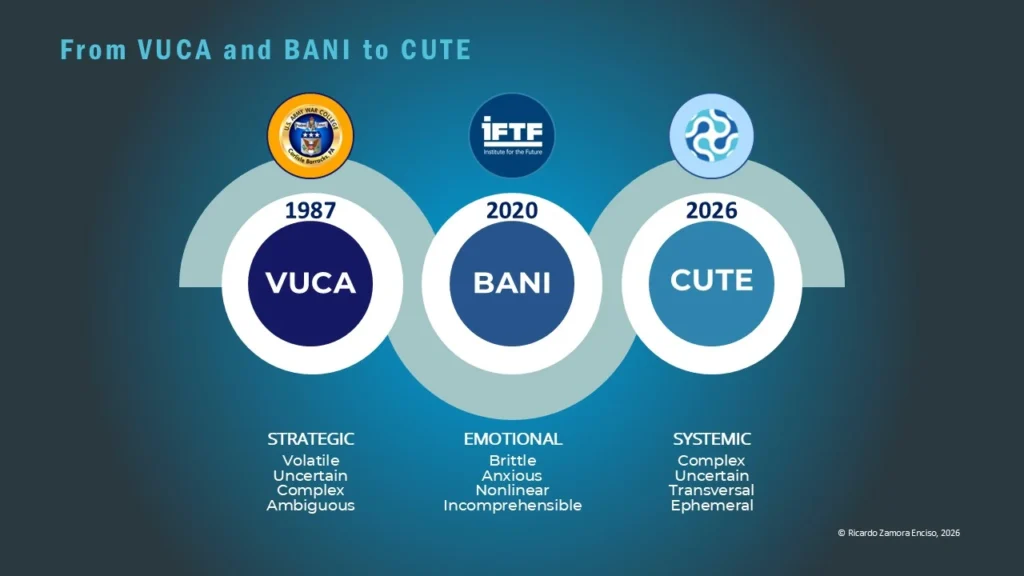
As we saw in the introduction to the model, the Cooplexity model serves as a compass, guiding us through a map that leads to full trust, the point at which those objectives are naturally reached. And why do I need a map? Because in a context like today's, complex, uncertain, transversal, and ephemeral (CUTE), the individual does not have all the answers, but the team can generate them.
Article Content
- The trust map
- The map and its two logics
- The Trust Development Stages: Three Levels of Organisational Maturity
- From coalition to collaboration: three degrees of behaviour
- Practical tools: diagnosis and action, step by step
- The EPIC rule: an actionable synthesis
- Trust as a competitive advantage
- Conclusion
- References
The trust map

In almost every programme in which I explain the model, the same question arises at the same moment: once the team has understood the model as a whole, but feels uncertain about exactly where it stands. Then someone, usually the person leading the group, pauses mid-session and asks: "But where are we in the overall process? How do we identify our situation? And is it the same for everyone?"
It is a perfectly reasonable question, and its appearance at that moment is no coincidence. Working through the six steps of the Cooplexity model in depth inevitably has a cost: the loss of perspective on the whole. When uncertainty management, relationship-building, or collaborative negotiation are addressed in detail, the model presents itself as a sequence of discrete steps.
Once the overall process is understood, James no longer needs more techniques. He needs to know where his team stands and what to do next. That is exactly what the trust map offers: not a list of best practices, but an architecture that enables accurate reading of the situation and appropriate action.
Reducing distrust and building trust are two distinct processes. They require different analyses, different catalysts, and different interventions. The map makes both visible at the same time.
The map and its two logics
The trust map places the six steps along a continuous axis, running from defensive distrust to full collaboration. What it reveals is not only the sequence but also the distinct nature of each step's contribution to the process.
The first three steps, uncertainty management, relationship management, and interest management, serve what Frederick Herzberg would call a hygiene function: their presence stabilises the relationship, but does not drive it forward; their absence deteriorates it. The work at these steps is not one of construction but of reduction: eliminating what prevents trust, the insecurity that generates defensiveness, the caution that breeds mistrust, the individualism that breeds self-interest. Each step has a transition catalyst: the specific practice that, when developed, activates progress towards the next step. In the first three, active curiosity, active empathy, and collaborative negotiation act upon anxiety, distance, and conflict of interest.
The following three steps, values-based management, change management, and distributed organisation, serve a motivational function: they do not contribute to the absence of distrust, but to the active presence of trust. The work is no longer one of reduction but of activation: the values that generate collective awareness, the equity that produces reciprocity, the commitment that generates generosity. Their transition catalysts, coherence, assertiveness, and recognition, act upon purpose, difference, and the individual's contribution to the whole.
The practical implication of this distinction is direct: interventions that work in the first three steps prove insufficient in the last three. The initial work is necessary, but not sufficient. Cohesion requires a shared project and common values, not merely more information or better agreements. This is the distinction most frequently overlooked in organisational development programmes: the hygiene function is addressed with motivational tools, or vice versa, with predictably poor results.
Returning to the manager from the opening, whom, for narrative purposes, we shall call James, we discussed how those individuals acting purely in self-interest are anchored at step 3. The first thing we must do is understand that having personal interests is legitimate and that defending them is not cause for disapproval, but for alignment. In fact, the goal is not to defeat those interests but to balance them. No one at this level will give up clear, tangible personal benefits in exchange for diffuse, hypothetical collective ones without a good reason. In this particular case, real, yet very common, what we did was to use collaborative negotiation to demonstrate, from an objective and rational standpoint, that in the long run there is more to be gained by balancing individual interests with collective ones. But, crucially, at the same time we involved the person in a dynamic that rewarded them emotionally and gave them a stake in a shared project. As we saw in the third step, the combination of reason and emotion was key in this case; we would not have achieved their progression to step 4 without both approaches. They were now fully integrated into the team.
The Trust Development Stages: Three Levels of Organisational Maturity
Once the person, let us call him David, felt that he belonged to a team and understood its advantages, what remained was to consolidate that belonging. Whilst the catalysts for each step in the trust map are relational (someone exercises them towards or with another person), the three levels of the Cooplexity model offer a perspective on team dynamics. They enable determining where a team currently stands and which intervention corresponds to that level. In James's case, the diagnosis pointed to an intermediate level: David had already moved beyond the individual phase, but the team had not yet consolidated its identity as a group.

The diagram organises the three levels along two axes. The vertical axis measures the degree of complexity, understood as the result of combining interrelationships (human relations) and interdependencies (mutual accountability), which grows as the team progresses from the individual to the organisational sphere. The horizontal axis represents communication, which evolves from information exchange to continuous feedback.
The knowledge level is individual. People reduce uncertainty by acquiring, understanding, and exchanging information about the environment, tasks, and one another. The maturity criterion at this level is autonomy: someone has reached the knowledge level when they can act without constant validation. "I know how to do it." The appropriate interventions at this level are those that broaden access to information and develop tolerance for error.
The transition catalyst at this level is proactive exploration: an initiative oriented towards both results and relationships that transforms uncertainty into knowledge and enables progress towards cohesion.
The cohesion level is collective. People come together around a shared project and develop a common commitment that enables sustained cooperation. The maturity criterion is no longer individual but collective. A team has reached cohesion when its identity as a group exceeds the sum of its individual identities. "We want to do it." The appropriate interventions at this level are not informational but purposeful: shared projects with genuine weight, processes that reinforce perceived equity, and spaces where shared values are expressed in concrete decisions.
The transition catalyst at this level is the shared project: the common objective that transcends routine work, acts as an attractor for cohesion, and prepares the team to coordinate autonomously.
The self-coordination level is organisational. Teams that have developed knowledge and cohesion can coordinate without the need for centralised instruction. They act on their own judgement, recognise the contributions of others, and adjust their behaviour to serve the good of the system. "We are doing it." The appropriate interventions at this level are not developmental but recognitional: visibility of individual contributions, structures that sustain decentralisation, and metrics that capture collective impact.
The transition catalyst at this level is interconnections: the meeting points between people that allow knowledge and cohesion to become spontaneous coordination, without depending on centralised instructions.
The distinction between levels has a direct practical implication: a team stalled at the cohesion level does not need more information; it needs a project that challenges it. A team stalled at the knowledge level does not need a more inspiring purpose; it needs to reduce operational uncertainty. Applying the right intervention at the wrong level is the most frequent error in organisational development programmes.
First, we must identify where we are.
Diagnosis: At which level is the team?Level | Sphere | Maturity criterion | Key phrase |
|---|---|---|---|
Knowledge | Individual | Autonomy: acting without constant validation | "I know how to do it" |
Cohesion | Team | Collective identity: the group exceeds the sum of individuals | "We want to do it" |
Self-coordination | Organisational | Emergence: distributed leadership arises naturally | "We are doing it" |
Once the level has been identified, we must define the intervention.
Intervention: What to do at each level?
Level | Transition catalyst | Appropriate intervention |
|---|---|---|
Knowledge | Proactive exploration | Access to information and tolerance for error |
Cohesion | Shared project | A shared project with genuine weight, perceived equity, and values expressed in concrete decisions |
Self-coordination | Interconnections | Recognition of individual contributions, decentralised structures, and metrics of collective impact |
The practical value of the framework lies in the precision it generates: not "what does this team need to improve?", but "at which level does it stand, and what type of intervention corresponds exactly to that level?"
From coalition to collaboration: three degrees of behaviour
And now what? We have David integrated into a team that prioritises, or at least balances, individualism with the value of collaborative work, with a shared vision and team identity. He has come from agreements, interests, and ad hoc coalitions, and is beginning to cooperate with others. How does this develop?
In general, the trust map describes the process architecture. But a map does not tell you where the team is; that is what observation tells you. Broadly speaking, teams that move through this process tend to operate in one of three distinct degrees of collaborative behaviour. These are not stages of the model, nor categories with specific interventions attached. They are observable behaviours that allow you to recognise where a team stands at any given moment.

In coalition, interests are shared, and agreement is obvious. Everyone gains, no one loses. The level of interdependence is minimal: coordination is straightforward precisely because the cost of cooperating is almost zero. Coalition is a valid starting point, but an insufficient destination. Teams that operate permanently at this level tend to avoid projects that involve asymmetric risk or differentiated effort.
In cooperation, interests are no longer identical but parallel. Some gain more than others, but no one loses. The system is sustained through compensation and direct reciprocity. Coordination requires clear roles, explicit agreements, and a certain degree of oversight. It is the most common level in organisations: functional, reasonably efficient, but structurally incapable of generating emergence. Results are designed, not emergent.
In collaboration, the logic changes fundamentally. The actors function as a system. Some accept individual costs for the benefit of the whole, because trust guarantees that this effort will be recognised and reciprocated. The result is not designed: it emerges from the interaction of people who share judgement, purpose, and the capacity to act autonomously.
The leap from cooperation to collaboration is the most demanding of the three. It is not the result of a change in attitude or a managerial decision. It is produced by the accumulated development of the six steps of the model: without awareness of shared purpose (step 4), without perceived equity (step 5), and without effective decentralisation (step 6), genuine collaboration does not emerge.
David, and in fact not just him, but the entire team, was at step 4. With them, we had to work on a reality that, though obvious, is difficult to accept. We are different; we are motivated by different things, we interpret reality differently, and we react differently to the same situation. The fundamental distinction between this level and the empathic approach of step 2 is that it is no longer just about connecting and getting along; it is about reaching an agreement. And that, my friend, is harder than it sounds. The organisational situations in which James's team became stuck at step 4, and the concrete impact of working on coherence as a catalyst, are described in detail in the corresponding diagnostic tool further below.
The catalyst for step 5 is assertiveness. Being able to discuss things constructively, drawing on each other's contributions whilst still defending your own ideas and not abandoning your perspective, demands that all viewpoints be dignified, given their proper value, made objective, and, where necessary, challenged without causing offence. The organisational contexts in which this blockage most frequently appears, and the transformation that assertiveness produces when properly applied, are captured in the diagnostic tool for step 5.
Practical tools: diagnosis and action, step by step
To address James's question, "how do I know which step I'm at?", we must first recognise what the team is currently experiencing and the pain that it is causing.
The six blocks below organise each step of the model as a diagnostic tool. Each one starts from specific, frequently occurring organisational situations, describes the pain they generate, identifies the corresponding catalyst for that moment, and describes the expected impact when the intervention is the right one.
The logic is straightforward: the correct intervention depends on the level, not on the urgency. Applying the wrong tool at the wrong step does not produce results; it produces frustration.
Step 1 — Uncertainty management
This step is activated in moments when the environment changes abruptly or unpredictably: a merger or acquisition in its early stages, the arrival of a new leader who resets the rules of the game, an organisational restructuring, the implementation of a new technology that alters established processes, or entry into an unfamiliar market. In all these cases, the common denominator is not the change itself: it is the loss of reference points that the change produces.
Pain | Catalyst | Impact |
|---|---|---|
People do not know what is expected of them, whether they have the necessary capabilities, or what comes next. Paralysis replaces action. | Active curiosity. Exploring, testing, and iterating without waiting for prior certainty. Accepting error as part of the process, not as a sign of incompetence. | Reduction of individual anxiety. Increase in autonomy. The person moves from waiting for instructions to acting on their own judgement. |
Step 2 — Relationship management
This step appears when the people who need to coordinate do not really know each other or do not trust one another. It is the critical step in the formation of new teams, in the merging of departments with different cultures, in cross-functional projects between areas that have until now worked in parallel, and in hybrid or multicultural teams where physical or cultural distance adds friction to day-to-day work. It also frequently emerges in the aftermath of an unresolved conflict that has caused relational damage.
Pain | Catalyst | Impact |
|---|---|---|
People work together without knowing each other. Caution replaces collaboration. The other person is an unknown quantity, not an ally, and distance acts as a protective mechanism. | Active empathy. Understanding the other person's perspective, acknowledging their capabilities, and establishing an emotional connection that goes beyond their role and the immediate project. | Reduction of interpersonal mistrust. People begin to perceive each other as allies. Coordination gains fluidity without depending on protocols or constant oversight. |
Step 3 — Interest management
This step manifests when the interests of individuals or teams come into conflict, whether overtly or latently. The most frequent situations are internal competition between departments for resources or recognition; purchasing, sales, or strategic alliance processes; cross-functional projects in which resources are scarce and incentives are misaligned; and restructuring processes that affect roles, competencies, or spheres of influence. It is also the step that explains why some people, perfectly capable and reasonable, act in ways the system perceives as self-serving.
Pain | Catalyst | Impact |
|---|---|---|
People defend their position because the system does not guarantee that yielding is safe. Self-interest is not moral; it is rational. No one gives up tangible personal benefits in exchange for diffuse collective gains. | Collaborative negotiation. Identifying each party's underlying interests, making the gains from agreement visible, and building long-term commitments that generate value for the whole. | Reduction of defensive self-interest. People cooperate because they perceive that the system balances contributions and benefits. The team moves from ad hoc coalition to sustained cooperation. |
Step 4 — Values-based management
This step is activated when cooperation exists but lacks conviction. It is the typical scenario in cultural integration processes following a merger, in strategic shifts that require a new team identity, in organisations where high turnover has eroded accumulated culture, and in international expansions where teams with very different cultural frames of reference coexist. It also appears in teams that have been together for a long time but have never built a real "we" beyond the task at hand.
Pain | Catalyst | Impact |
|---|---|---|
People cooperate out of obligation or incentive, not out of conviction. There is no real "we." Decisions are made in accordance with departmental or personal interests, not with the system as a whole. | Coherence. Aligning what the team declares it believes with what it actually decides under pressure. When values are expressed through observable, consistent behaviours, they generate genuine trust. | Emergence of collective identity. The team acts as a system, not as the sum of its individuals. Decisions incorporate shared judgement. The "we" becomes an operational reference. |
Step 5 — Change management
This step arises when the team has built cohesion but becomes stuck when faced with difference. It is the situation found in digital transformation processes with internal resistance, in leadership teams going through generational change, in teams where very different profiles, technical, creative, and commercial, coexist without being able to draw on each other's strengths, and in any cultural change process where latent conflict prevents progress. The paradox of this step is that the problem is not a lack of cohesion; rather, the cohesion already achieved has become rigid.
Pain | Catalyst | Impact |
|---|---|---|
The team functions well with the familiar but becomes blocked when faced with different perspectives. Diversity generates friction rather than value. Uniformity is mistakenly perceived as a sign of cohesion. | Assertiveness. Defending your own perspective with clarity and respect whilst genuinely integrating the other person's perspective. It is neither aggression nor deference: it is firmness and openness together. | Diversity ceases to be a source of friction and becomes an advantage. The team develops reciprocity: the certainty that individual effort will be recognised and reciprocated by the system. |
Step 6 — Distributed organisation
This step appears when the team has both judgement and cohesion, but the system continues to function in a centralised manner. It is the situation found in organisations that have grown beyond the management capacity of a single decision-making centre, in high technical complexity teams that cannot be supervised in detail, in matrix structures where reporting lines multiply, and in organisations that retain senior talent but fail to sustain its autonomy. It is also the step that explains why many excellent teams become mediocre when their leader is absent.
Pain | Catalyst | Impact |
|---|---|---|
The team has judgement and cohesion but continues to wait for instructions. Concentrated leadership creates bottlenecks. When the person in charge is absent, coordination deteriorates or stops altogether. | Recognition. Making individual contributions systematically visible. When effort is consistently perceived and valued, initiative is sustained without the need for external supervision. | Self-coordination. The team makes local decisions aligned with the global strategy without centralised instructions. Leadership emerges as a property of the system. Trust becomes culture. |
A word of caution about the use of these tools: the situations that head each block do not activate a single step. A merger triggers anxiety in the initial phase (step 1), relational distance during integration (step 2), and conflict of interest in the negotiation of roles (step 3). The same is true of a restructuring, a leadership change, or a complex cross-functional project.
The model does not establish that each situation corresponds to a single step. It says that each situation activates a specific pain at each moment in the process, and that this pain requires a precise intervention. The question that guides action is not "what is happening?" but "at which step is the pain manifesting right now, and which catalyst corresponds to this moment?"
The EPIC rule: an actionable synthesis
James had the diagnosis. What remained was the rule for action. That is what EPIC is for. If everything had to be distilled into a single sentence, it would be this: Explore within the framework of a common Project, fostering Interconnections, through Communication.

EPIC summarises the essential elements of the method in a memorable rule, validated with more than 600 executives across 52 teams in 12 sectors: Explore within the framework of a common Project, fostering Interconnections through Communication.
Exploring means acting in the face of uncertainty without waiting for instructions or prior certainty. It is the lever of the knowledge level: those who cannot tolerate error do not learn, and those who do not learn do not develop the self-confidence needed to act in complex environments. Exploration does not replace training or consultancy, but it activates something that neither can activate on its own: the capacity to build independent judgement in real time.
The shared project is the catalyst for cohesion. A common objective that goes beyond routine work challenges, focuses resources, and provokes. Without a shared project of genuine weight, cohesion has nothing to build on. In systems terms, the project acts as an attractor: it orients the group's behaviour without the need for constant instructions.
Interconnections are the meeting points between people. A well-interconnected team has the channels needed for information to flow without depending on hierarchy. Without them, self-coordination cannot emerge, and knowledge and commitment remain trapped in silos, regardless of what the organisational chart says.
Communication occupies a different position within EPIC. It is not a third catalyst on the same level as Exploration, the Common Project, and Interconnections; it is the medium through which the other three operate. In the Cooplexity model, communication does not consist of transmitting data or managing messages. It is understood as the process of interaction through which people make decisions and construct new realities that did not previously exist. From this perspective, communication does not describe what happens: it produces it.
The value of EPIC lies in the question it poses: when a team is stuck, which of the three catalysts (Exploration, Project, Interconnections) is absent or weakened? And it is the medium that activates them (Communication), functioning? The answer guides the intervention with surgical precision. In this case, the question was straightforward: the team had a project (step 4 already activated) and was working on communication, but this was an internal activity. Interconnections between departments were scarce: the team functioned well internally but was not generating the bridges needed to coordinate with the rest of the organisation. Working on those connections was what made it possible to move from cooperation to genuine collaboration.
Trust as a competitive advantage

Trust is not a stated value, nor a diffuse cultural objective. It is a variable that determines an organisation's speed of response, its capacity to retain talent, and its ability to generate solutions that no individual would have produced alone.
In low-complexity environments, coordination can be sustained through processes, hierarchies, and control systems. In CUTE environments, complex, uncertain, transversal, and ephemeral, the pace of change exceeds the capacity of any control structure to anticipate and respond. The only thing that sustains coordination in that context is trust: the shared certainty that each person will act with judgement, autonomy, and orientation towards the common good, even when no one is watching.
Organisations that have developed that trust do not respond faster because they have better processes. They respond faster because they do not need to escalate every decision. Their teams have the judgement to act, the knowledge to decide, and the cohesion to coordinate without instructions. Self-coordination is not an aspiration; it is the measurable result of completing the full process.
The Cooplexity model does not hold that trust is desirable. It proposes that trust is quantifiable, that it develops in a determined order, and that this process, applied rigorously, transforms the way teams operate, decide, and adapt. Data from 52 teams across 12 sectors show a statistically significant correlation between the level of trust development and the quality of results in high-complexity environments.
The relevant question for any organisation is not whether it trusts its teams. It is at which level of trust each team stands, and which concrete intervention corresponds to that level. The map exists to answer precisely that question.
Conclusion
The Cooplexity model is not a collection of steps. It is a system. And like any system, it can only be fully understood when the architecture that organises it, the mechanisms that activate it, and the result it points towards can all be seen at the same time.
The trust map does exactly that: it reveals that the six steps are not equivalent to one another, that they operate according to different logics depending on their function in the process, and that interventions effective in the first three steps prove insufficient in the last three. The distinction between reducing distrust and building trust is the one most frequently overlooked in organisational development programmes. And it is the one that, once understood, changes how one analyses and intervenes.
The three trust development stages, Knowledge, Cohesion, and Self-coordination, constitute the analytical framework. EPIC offers the rule for action. Trust, as a competitive advantage, provides an argument for decision-makers. Three layers of analysis that allow one to move from understanding the model to applying it with precision.
If you have recognised yourself at any point along this journey, in the manager from the opening, in the stalled team, in the difficulty of moving from cooperating to collaborating, the most useful question you can ask yourself is: at which level is my team right now, and which intervention corresponds to that level? If you want to answer it with data, I can help you. Contact me directly through this site.
References
Herzberg, F., Mausner, B. & Snyderman, B. (1959). The Motivation to Work. John Wiley & Sons.
Zamora, R. (2020). Cooperation in complexity: Cooplexity, a model for collaboration in complexity in times of uncertainty and change. Ricardo Zamora.
ResearchGate